The Pocket Watch and the Changing Meaning of Punctuality
The pocket watch and punctuality: see how a portable timepiece could connect personal schedules with shared expectations, without making every owner punctual.
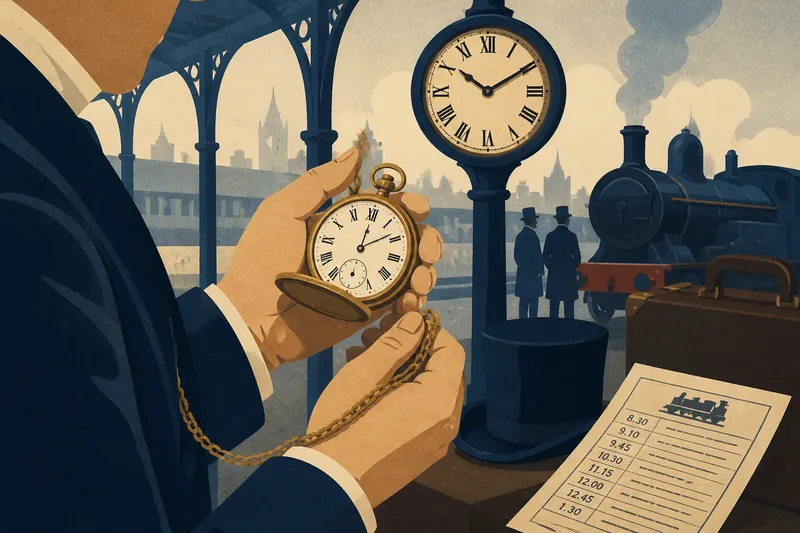
At a railway platform in Victorian Britain, a traveller might compare a pocket watch with the station clock before a train departed. The pocket watch and punctuality became linked through settings such as railway travel, where a shared timetable made an individual’s arrival matter to other people. That link did not mean every person owned a watch or followed time in the same way.
A pocket watch made time portable for some owners
In the eighteenth and nineteenth centuries, pocket watches were costly objects, and access to them varied by wealth, occupation and place. They were not ordinary possessions for everyone. Public clocks, church bells, daylight, household routines and work customs continued to mark time for people without a personal timepiece, as well as for watch owners.
A watch gave its owner a time display away from a fixed clock. Its usefulness depended on circumstances: a traveller could check it while walking to a station, while someone working within earshot of a bell might rely on that public signal instead. The object added a personal reference; it did not replace communal ways of organising the day.
That distinction matters. A watch could help someone manage an appointment, but the appointment’s hour came from an agreement or institution, not from the watch itself.
Railway timetables connected private time to public schedules
Railway travel made coordination across places a practical concern. A timetable set out departures and arrivals, while station clocks gave travellers a public point of reference. A pocket watch could help an owner act on that schedule, but its reading was useful only insofar as it matched the time standard used by the railway.
Say Elias, an invented traveller in Victorian Britain, plans to meet a colleague before a train journey. He has a pocket watch, and the station displays a clock. He checks the watch against the station clock, follows the printed timetable, and reaches the platform before departure. The observable result is that his personal timekeeping and the railway’s schedule align for this journey; it does not show that all travellers owned watches or that the watch alone caused his punctuality.
If the watch and station clock disagree, Elias must decide which reference to follow. For catching the train, the railway’s stated schedule and station arrangements matter more than his private display. The episode shows how personal responsibility operated within shared systems rather than replacing them.
Why did a pocket watch become a social signal?
Who could own a pocket watch?
Ownership varied, and a pocket watch should not be treated as a universal possession. Its cost and the owner’s work or social circumstances shaped access, while people without one could use public clocks, bells or established routines.
Did watches make everyone punctual?
No. A watch could help its owner consult the time, but punctuality depended on shared schedules, transport arrangements and other people’s expectations. A personal timepiece could not make those systems fair or reliable.
Why could punctuality seem like a personal duty?
In a setting where a train, shift or meeting followed an agreed hour, arriving late could affect other people. A watch helped an owner track that hour, but the duty arose from the social arrangement, not from the object alone.
What can a pocket watch tell us about its owner?
Its design and signs of wear can offer clues about how it was carried or displayed. They cannot, by themselves, establish the owner’s habits, punctuality or beliefs about time.
What should you ask when interpreting a pocket watch?
- Check the setting. If records place the watch in railway travel or timed work, relate it to those schedules; if the setting is unknown, avoid assigning it a specific routine.
- Check the evidence for ownership. If a family record names an owner, describe that connection cautiously; if no record survives, call the owner unknown rather than guessing.
- Check for a chain or wearing marks. If these features are present, say they are consistent with carrying or wearing the watch; if absent, do not infer that it was never carried.
- Check whether a public time source is documented. If a station clock or bell appears in the record, discuss how it could coordinate people; if not, do not claim the watch was set against one.
- Check the watch’s working condition only where evidence permits. If a dated repair record exists, use it to describe maintenance at that point; if none exists, do not infer whether the watch kept accurate time.
- Check what an appointment or timetable required. If a written schedule survives, explain the expectation it set; if it does not, distinguish the watch’s function from any unrecorded obligation.
These questions keep interpretation close to what the object and its context can support. They also leave room for uncertainty, which is essential when a surviving watch is detached from the routines in which it once mattered.
A watch could support discipline without creating it
A pocket watch might help someone notice the hour before a train departure or meeting. The reason to be there at that time came from a timetable, workplace rule or personal agreement. Treating the watch as the cause of punctuality confuses the instrument with the expectation it helped someone follow.
Nor should the watch be used as proof of an owner’s character. A polished case or visible chain may indicate care or display, but neither establishes reliability. Historical interpretation is stronger when it distinguishes an object’s possible use from claims about a person’s private habits.
The relationship between the pocket watch and punctuality was therefore specific, not universal: portable timekeeping could make shared schedules easier for some people to follow, while older public and local rhythms continued alongside it. When you encounter a pocket watch in a collection or family archive, look for evidence of the schedule, institution or meeting that made its time useful—and keep the limits of that evidence in view.