A Family Recipe Card as a Record of Change
Read a family recipe card as a record of change: trace altered measurements, revised instructions and omissions to see household practice shift.
What can a family recipe card tell you besides how to make dinner? A family recipe card can preserve small changes in household practice: a measure made more precise, an ingredient crossed out, or a method left unexplained because someone already knew it by heart. Set one on the table with a pencil and a few minutes of quiet attention. Read it as an object shaped by use, not as a complete account of the past.
Start with the card, not the story attached to it
Before asking who wrote the recipe, notice the card itself. Look at its paper, ruled lines, stains, folds and handwriting. A grease mark may show where a thumb held the card open; a softened corner may suggest it was handled often. These details can suggest use, but they do not identify a cook or a particular occasion on their own.
Record what you can see separately from what you infer. “Ink is darker on the ingredient list” is an observation. “The recipe was recopied after a spill” is a possibility. Keeping those apart makes the reading more useful, especially if relatives remember the card differently.
Use a phone photo or a simple transcription if the card is fragile. Keep the original wording, spelling and line breaks in your notes before normalising anything. A misspelling or unusual abbreviation may be part of the card’s history, not a defect to tidy away.
Read revisions as layers of household practice
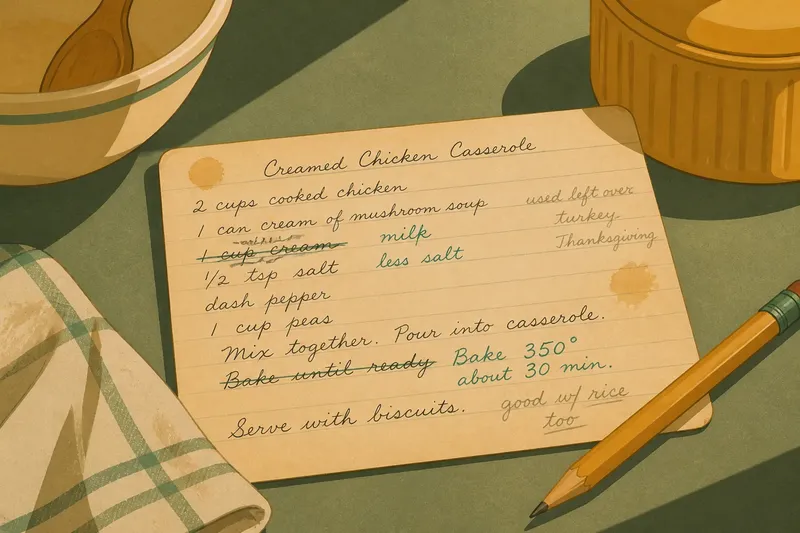
Crossings-out, insertions and changes of ink can reveal that a recipe was adjusted over time. A handwritten “less salt” beside a typed instruction records a decision, though not necessarily when or why it was made. A replacement ingredient may reflect preference, availability, or a change in the people eating the dish. The card usually cannot distinguish among these explanations by itself.
Notice whether an alteration is integrated into the recipe or sits beside it. A new instruction written in the margin may have been an occasional adjustment; a clean rewrite may indicate that the change became part of the working version. Treat this as a clue about how the recipe was used, rather than a firm chronology.
Say you find “stir in cream” crossed out and “milk” added above it. Note the two versions and ask a family member, if available, whether either was associated with a particular cook or occasion. If nobody knows, preserve the uncertainty instead of turning a plausible explanation into family fact.
Measurements show what the writer expected a cook to know
Measurements are especially revealing when they shift from broad to exact. “A cup” may sit beside a later note specifying a particular cup, while “a handful” leaves more room for judgement. This does not make one version more reliable than another. It suggests different assumptions about the reader’s confidence, tools or habits.
Look for units that belong to different systems, such as ounces alongside cups, or for quantities added in another hand. Such combinations may indicate that someone adapted the card for a new kitchen or a different way of measuring. They can also reflect ordinary convenience. Avoid assigning a date or a household move from units alone.
Pay attention to quantities without a unit. “Two” could mean eggs, spoonfuls or something understood from the line above. If the card leaves that unclear, mark it as unclear. The gap is part of the evidence: the original writer may have expected a familiar reader to fill it in.
Omissions can mark shared knowledge
A recipe may name ingredients but give little guidance about heat, texture or timing. “Bake until ready” assumes a cook can recognise the result; “add flour” may omit a quantity because the mixture’s feel mattered more than a fixed measure. These silences do not mean the card was carelessly written. It may have served as a reminder for someone who already knew the routine.
Notice which directions are detailed and which are absent. If the card specifies how to prepare an ingredient but says nothing about serving, the writer may have treated that preparation as the uncertain part. If it gives a serving suggestion but not a temperature, the intended cook may have known the equipment. These are possibilities to test against the card, not conclusions about everyone in the household.
Ask what the recipe assumes: a particular pan, a familiar oven, a certain ingredient already in the cupboard, or someone present to demonstrate the technique. A missing instruction can point towards knowledge carried by conversation and practice rather than by writing.
Which questions help read a recipe card?
What does a crossed-out ingredient mean?
It records a change, but the reason may be unknown. Note the original and revised wording, then seek context without treating a guess as settled history.
Can measurements reveal when a recipe was written?
They can offer clues about the writer’s habits and intended reader, but they rarely establish a date by themselves. Compare units and handwriting cautiously, and keep the date open unless the card supplies firmer evidence.
Why does the card leave out cooking times?
The writer may have expected a familiar cook to judge heat and texture by sight or touch. The omission can show how much practical knowledge sat outside the written recipe.
Should I rewrite the card into a usable recipe?
Make a separate working copy if you want to cook from it. Preserve a transcription of the original first, so later readers can distinguish the card’s wording from your clarifications.
Keep interpretation and preservation side by side
For a quiet afternoon’s notes, use three short columns: what the card says, what you observe about it, and what might explain the difference. This keeps revisions, material clues and family memories in view without blending them together. Add the name of anyone who supplied a recollection and the date you spoke, so later readers know where that context came from.
Store the card somewhere dry and out of direct sunlight, away from food preparation. If it is brittle, heavily stained or otherwise fragile, avoid flattening folds or applying tape; ask an archivist or conservator for advice if its condition requires specialist care. Keep a clear image with the transcription so the layout and handwriting remain available for comparison.
The most useful reading of a family recipe card may leave some questions unanswered. Preserve the crossed-out words, the loose measures and the missing directions alongside any family explanation. That way, the card remains evidence of change—and a practical recipe—rather than being made to tell a tidier story than it can support.